Pai Walking Street: Food, Stalls and an Evening in Town
Written by Nolo Hub Pai, Pai’s top social and experience-based hostel
Last checked September 2026
tl;dr
Pai Walking Street is the town’s evening market along Chaisongkram Road, running from the central junction towards the Pai River. As the day cools, food carts and small stalls take their places along the road. By evening, it’s where people drift down for dinner, browse handmade goods and decide whether to stay out for another drink.
Also known as: Chaisongkram Road · ถนนชัยสงคราม · ถนนคนเดินปาย · Pai Night Market
At a glance
- Where
- Chaisongkram Road, from the central junction towards the river
- When
- Stalls usually start appearing around 17:00–18:00; most pack up around 22:00
- How long
- About ten minutes end to end if you don’t stop, or half an hour or more once you start looking and eating
- Entry
- Free
- From Nolo Hub
- Around 10–15 minutes on foot
- Bring
- Cash for the food and smaller stalls
- Good to know
- This remains a road with passing traffic
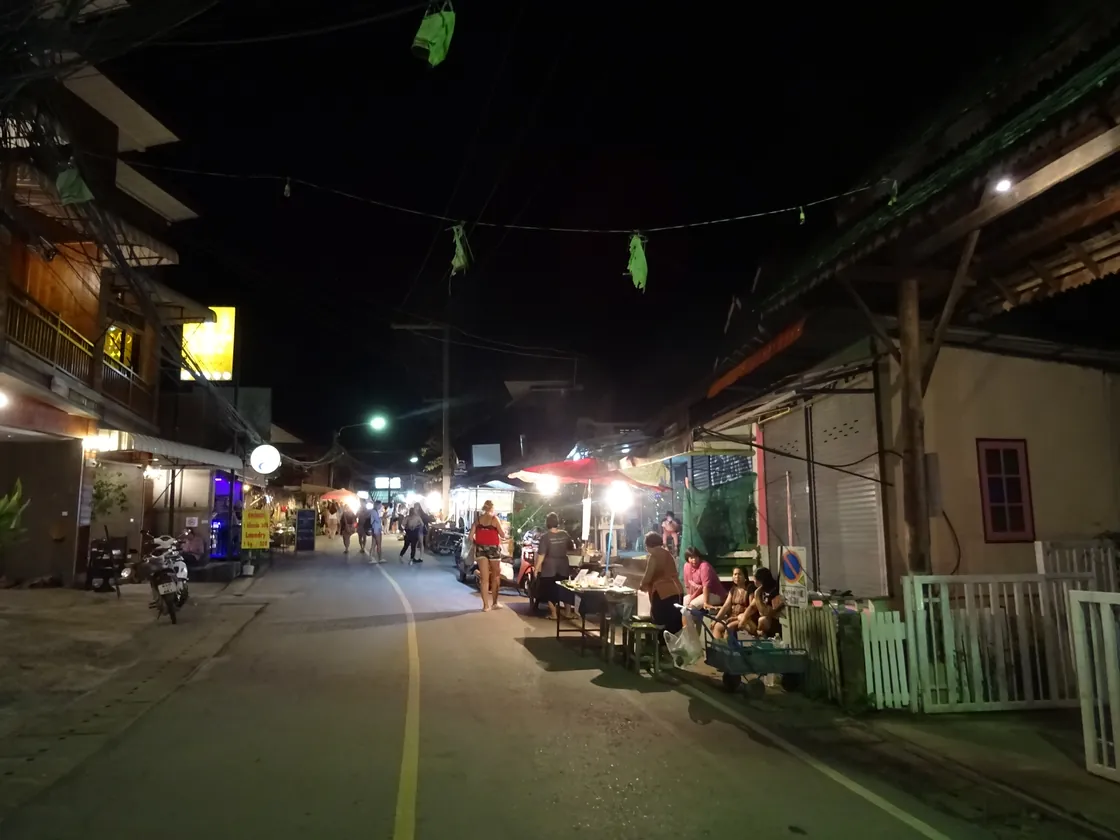
Despite the name, don’t assume it’s a pedestrian-only street. Motorbikes and cars can still come through, even when the road is busy with people. Enjoy the walk, but make room and keep an eye out for traffic.
Come hungry
Food is the easiest reason to wander down. You’ll find regional Thai dishes alongside food from further afield, with plenty that’s made to carry as you walk. Gyoza, spring rolls and other quick bites sit among grills, snacks and sweets; what’s available shifts with the vendors and the season. The spots where the gyoza and spring rolls are sold have hosted trade for over forty years.
Keep an eye out for khao puk nga dam. It’s made from pounded black glutinous rice and toasted black sesame, shaped into a flat cake and grilled until the outside catches a little colour. It may be served on a banana leaf with something sweet, such as sugarcane syrup. Originally associated with the cooler season after the rice harvest, it’s now a familiar sight on Pai’s evening street.
You can find places to sit, but Walking Street is best enjoyed as a slow wander: pick up one thing, eat it, then see what catches your eye farther down.
Follow the street towards the river
The stalls aren’t all selling the same things. Alongside food and souvenirs, look out for textiles, silverwork, artwork and woodcarvings, particularly towards the river end. Some sellers have held familiar spots for years; others are new from one season to the next. That’s part of why the street is worth revisiting if you’re staying in Pai for a while.
The market didn’t begin as the organised evening strip you see today. Older accounts recall villagers and people from the surrounding highlands laying out goods along the roadside.
In the late 1980s and 1990s, Shan villagers and women from the hill villages came down in the afternoons and spread woven mats, pha pou, on the dirt roadside outside the bus station. They sold silver, textiles, honey and mountain produce, with cooks at charcoal stoves beside them. When it began blocking traffic in the early 2000s, the town formalised it, and painted the pitches where the mats had been. Only Pai’s veterans remember it now; nothing marks it.
The rows of stalls grew from that smaller trade. Chaisongkram Road is still an ordinary working street by day, which makes its change each evening easy to notice.
It runs through Wiang Tai, the “southern walled town”, though there is no sign of a wall today.
When to go—and when it winds down
There’s no opening bell. Carts begin arriving around 17:00–18:00, sometimes earlier in the busier season, and the food stalls gradually fill the roadside. If you want dinner, the early evening gives you the most choice.
The market is fullest in the cool season, which is peak season for visitors and the quieter end of the farming year, when people come into town to sell and go back to the fields.
Most sellers begin packing up around 22:00, although a few stay later. That doesn’t mean the street goes quiet: bars and music carry the evening on after the market stalls have gone. A walk at 18:30 and one near midnight are two different versions of the same road.
Walking and parking
“Walking Street” is a market name, not a reason to step into the road without looking. Residents and people working on the street still need to get through. There may be traffic control at an entrance on a busy night, but you can’t take that as a sign that no vehicles will pass.
If you’re coming from Nolo Hub, walking is the simplest option. Riding a scooter along Chaisongkram Road while stalls and pedestrians fill it is slow and awkward, particularly from early evening until late at night.
Staying with us? There’s a free lift back from Walking Street until 9.30pm.
If you do park nearby, check the ODD/EVEN no-parking signs before leaving your bike. A crossed-out ODD sign means no parking on that side on an odd-numbered date—the 3rd, for example. A crossed-out EVEN sign applies on dates such as the 4th. Also avoid leaving a bike where a vendor needs to set up; one parked there in the afternoon may be moved when the evening stalls arrive.
Cash is handy, although there are ATMs and general stores along the street. Public bins can be scarce, so hold on to your rubbish until you find one. A stall will usually let you use theirs.
Walking Street is compact enough that you don’t need an itinerary for it. Start at the town end, follow the food towards the river, and give yourself permission to take much longer than the ten minutes the walk requires.