Tham Lod Cave, Pang Mapha
A river through the mountain
Written by Nolo Hub Pai, Pai’s top social and experience-based hostel
Last checked September 2026
tl;dr
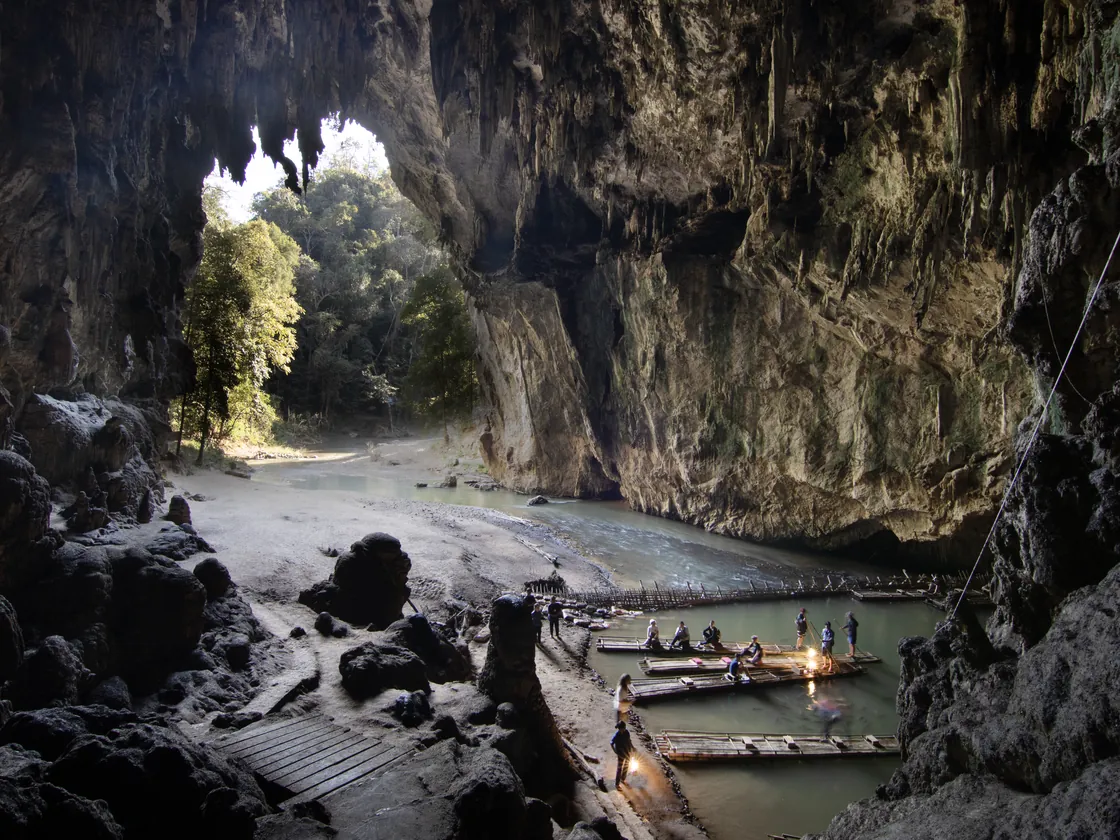
At Tham Lod, the Nam Lang River disappears into a mountain, flows through a vast limestone cave, and emerges on the other side. Visitors follow part of that journey with a local guide, a pressure lantern, and—on the full route—a bamboo raft.
Also known as: Lod Cave · Tham Lot · Lot Cave · ถ้ำลอด
Tham Lod at a glance
- From Nolo Hub
- Around 50 km; allow 1¼–1¾ hours each way
- Time inside the cave
- Allow around two hours for the full route
- How you visit
- A local guide and lantern are required
- Group size
- Up to 3 people, with one guide per group
- Cave system
- Around 1.6 km in total; the visitor route covers a smaller section
- What the full visit includes
- Walking, wooden stairs, uneven ground, and a bamboo raft
- Best for
- Curious travellers, cave lovers, archaeology, and a memorable day out
- Not ideal for
- Anyone needing level, step-free, brightly lit access
- Map
- Google Maps · Apple Maps
Published 2026 guide rates are structured by route and group:
| Route | Foreign visitors | Thai visitors |
|---|---|---|
| One cave | 350 THB per group | 270–310 THB per group |
| Two caves | 400 THB per group | 320–360 THB per group |
| Three caves and bamboo raft | 700 THB per group | 620–660 THB per group |
Thai prices vary with group size. Rates, water levels, and route access can change, so confirm the available route when you arrive.
A group is 3 people at most, with one guide to each group. Larger parties split into groups of three, and each group pays its own rate. For foreign visitors the rate is the same for one person as for three, so if you arrive alone it is worth teaming up with other visitors at the kiosk: three sharing the full route pay about 233 THB each.
The bamboo raft is part of the full-route price. When the rafts cannot run, the price drops; when they can, it is charged whether or not you ride.
Nolo Hub runs a group trip here: weekly in peak season, with local drivers and guides. More at the end of the page
Around 50 km northwest of Pai, the road climbs into the limestone country of Pang Mapha before turning towards the cave.
Tham Lod is not just a large cave to look at. It combines underground river passages, enormous limestone chambers, prehistoric burials, ancient wooden coffins, bats, swifts, and a landscape that has been used and studied for thousands of years.
It is one of the best day trips from Pai, but it is a proper outing rather than a quick stop.
What the visit feels like
Tham Lod is not a walk-through show cave.
You enter with a local guide carrying a pressure lantern. There is no permanent electric lighting in the main visitor route, so the cave appears in fragments: a section of rock, the shine of water, a column rising into darkness, a staircase disappearing around a bend.
The route includes wet and uneven ground, wooden stairs, and bamboo-raft crossings on the river. Water levels affect which chambers can be reached, so the complete three-cave route is not available every day.
If you are comfortable with darkness, damp footing, and a little unpredictability, Tham Lod is one of the most memorable experiences near Pai. Wear shoes with grip and take your time.
A river through limestone
The most useful thing to understand about Tham Lod is that the river is not simply something inside the cave.
The Nam Lang River created the cave.
Over a very long time, water moved through the limestone, carving passages through the mountain and leaving behind chambers, columns, stalactites, stalagmites, and flowstone. The main river passage itself extends for roughly 600 metres.
The scale changes constantly as you move through it. One moment, you are watching your footing beside the river. The next, the roof rises and you are standing in a chamber large enough to make the lantern light feel very small.
The three principal chambers are:
- Column Cave, known for its large limestone formations.
- Doll Cave, named for smaller stalagmites with doll-like shapes.
- Coffin Cave, where ancient wooden coffins remain in elevated galleries.
The formations are still part of an active cave system. Water continues to move through the mountain, and the cave changes with the seasons.
The Coffin Cave
The Coffin Cave is where Tham Lod becomes more than a geological spectacle.
The chamber contains elevated wooden coffins associated with the Log Coffin culture, a prehistoric mortuary tradition found across the Pang Mapha highlands. Large trees—often teak—were hollowed out and placed in caves and rock shelters as part of burial practices.
Across the wider Pang Mapha region, more than 40 caves and rock shelters have produced this kind of coffin. The tradition is broadly dated to around 350 BC–950 AD, although the exact history differs from site to site. The coffins at Tham Lod itself date from around 250–750 AD.
It is tempting to turn these coffins into a simple story about one ancient people. The archaeology is more careful than that.
The communities who created these burial places lived many centuries ago, and researchers are still working to understand their movements, relationships, and connections across mainland Southeast Asia. The coffins tell us that these caves were used for burial and ceremony. They do not give us a neat modern identity to attach to the people who made them.
That uncertainty is part of what makes the site important.
Tham Lod before the coffins
The coffins are ancient, but they are only one chapter in Tham Lod’s human history.
Archaeological excavations at the Tham Lod rockshelter have found evidence of people using the area during the Late Pleistocene.
A human burial from the site dates to around 11,650 BC, towards the end of the last Ice Age. Archaeologists have also found stone tools and evidence that parts of the rockshelter were used for working stone.
This does not mean people lived continuously in the cave all that time. It means that the Tham Lod landscape has drawn people back, in different ways and at different times, for a very long time.
The cave is older than the coffins. The coffins are older than the village. The river is older than all of them.
Bats, swifts, and the evening flight
Tham Lod is a living habitat as well as an archaeological site.
Large numbers of bats roost inside the cave, while cave swifts return in the evening. Around dusk, bats leave to feed as swifts fly back towards the cave entrance. The movement can be impressive, especially on a clear evening.
You do not need to be inside the archaeological chambers to see it. Watch from near the downstream entrance and give yourself time. The exact timing changes with the light, weather, and season.
Guides stop taking new tours at 17:00, and the tour that catches the flight normally sets off before then.
The birds and bats are not an added attraction. They are part of the cave’s daily life, continuing whether visitors are there or not.
The village and the cave today
Tham Lod sits beside a village, where local guides and raft operators make the cave visit possible.
The cave is not an isolated archaeological object hidden away from modern life. It is part of a village landscape, a protected natural area, a place of continuing research, and a source of work for people in the community.
That is worth remembering when you visit. Follow your guide’s instructions, do not touch formations or coffins, take your rubbish away, and allow the cave to be more than a backdrop for photographs.
Plan the day properly
Tham Lod works best as a full-day trip from Pai.
Leave with enough time for the drive, the cave route, and a meal nearby. The road from Pai is scenic but winding, and the cave experience is better when you are not rushing.
If you are travelling by scooter, take the route seriously. Highway 1095 has long bends, changing weather, and fast traffic in places. Ride within your confidence level, and pack warm clothes: it gets very cold on the ride home, especially after sunset.
For a simpler day, pair Tham Lod with Ban Jabo for lunch. Stop at Ban Jabo first, enjoy noodles and the mountain view, then continue to the cave for an afternoon visit.
A visit to Tham Lod begins with a river entering a mountain and a lantern moving through darkness.
Everything else—the limestone, the coffins, the archaeology, the birds, the village, and the people who guide you through it—makes that first simple image much larger.